
Search Colleges, Exams, Schools & more


Login
How to Tackle TITA Questions in CAT 2026: Tips & Strategies
CAT 2026 TITA (Type In The Answer) questions play an important role in the entrance examination and require a clear understanding of concepts and strong accuracy. Unlike MCQs, TITA questions do not offer answer options, so candidates must type the correct value or response on their own. These CAT 2026 questions test problem-solving ability, logical thinking, and calculation skills across VARC, DILR, and Quantitative Aptitude sections. Proper practice of TITA questions helps reduce errors, improve speed, and increase overall CAT score potential.
This Story also Contains
- What are the TITA Questions in the CAT 2026 Exam?
- CAT 2026 TITA Questions: Previous Year Trends (2025 vs 2023 vs 2022 vs 2021)
- CAT Exam TITA vs MCQ
- How to Build Accuracy Without Guesswork in CAT 2026 TITA Questions
- Time Management Tips for Non-MCQ Problems in CAT 2026
- Importance of TITA Questions for CAT 2026
- How to Tackle TITA Questions in CAT 2026?
- Types of TITA Questions in CAT 2026
- CAT TITA Questions Strategy 2026
- Mistakes to Avoid While Solving CAT TITA Questions
- CAT Ebooks 2026 by Careers360

In this article, we have discussed TITA questions meaning, how they differ from MCQ and problem solving tips.
Check Here- TITA Questions in CAT 2026
What are the TITA Questions in the CAT 2026 Exam?
TITA stands for Type In The Answer questions in the CAT 2026 Exam. These are non-MCQ questions where no options are provided; candidates must type the exact answer. TITA questions appear in all three sections, VARC, DILR, and Quantitative Aptitude. A good CAT TITA strategy 2026 includes careful reading, strong conceptual clarity, and avoiding guesswork. Unlike CAT MCQs, TITA questions do not carry negative marking, so it’s important to attempt them wisely to maximise marks.
CAT 2026 TITA Questions: Previous Year Trends (2025 vs 2023 vs 2022 vs 2021)
Candidates can check the CAT TITA question trends from previous years in the table below to get an idea before appearing in the CAT exam slot 2.
CAT Exam Year | CAT TITA Questions in VARC Section | CAT TITA Questions in DILR Section | CAT TITA Questions in QA Section | Total TITA Questions in the CAT Exam |
CAT 2025 Exam | 4 | 11 | 8 | 23 |
CAT 2023 Exam | 5 | 7 | 5 | 17 |
CAT 2022 Exam | 6 | 8 | 3 | 17 |
CAT 2021 Exam | 5 | 8 | 5 | 18 |
CAT 2019 Exam | 8 | 7 | 10 | 25 |
CAT 2018 Exam | 8 | 12 | 7 | 27 |
CAT 2017 Exam | 6 | 7 | 7 | 20 |
CAT 2016 Exam | 6 | 7 | 10 | 25 |
CAT 2015 Exam | 24 | 14 | 10 | 32 |
CAT Exam TITA vs MCQ
The CAT Exam TITA vs MCQ distinction plays a key role in shaping your overall CAT 2026 strategy. While MCQs (Multiple Choice Questions) allow option elimination and quick decision-making, TITA (Type In The Answer) questions test pure conceptual clarity since they offer no options or hints. Knowing how both question types work helps improve accuracy, time management, and percentile performance across Quant, DILR, and VARC sections.
| Detail | MCQs | TITA |
Answer Format and Style | Candidates choose one correct option from four given choices, which allows quick decision-making through elimination and reasoning | CAT TITA questions require you to type your numerical or short answer manually using the on-screen keyboard. High calculation skill is required. |
Marking Scheme and Penalty | MCQs follow a +3 for correct and –1 for incorrect pattern, which means poor accuracy can reduce your overall score. | TITA questions also carry +3 for a correct answer but no negative marking for wrong attempts, giving aspirants a low-risk scoring opportunity. |
Use of Guesswork and Elimination | MCQs allow partial advantage through option elimination and logic-based filtering, which can help even if you’re unsure of the complete solution. | TITA questions completely remove this comfort zone; you must arrive at an exact answer through strong conceptual reasoning, clear calculations, and proper data handling. |
Answering Technique | MCQs test recognition-based learning, identifying patterns, and conceptual understanding quickly. | TITA questions dig deeper, assessing logical deduction, calculation precision, and conceptual mastery. |
How to Build Accuracy Without Guesswork in CAT 2026 TITA Questions
The CAT 2026 TITA questions test conceptual clarity more than elimination skills. With no multiple-choice cues, every digit of your calculation matters. These questions appear mainly in Quantitative Aptitude and DILR, where precision and error-free reasoning decide your percentile. The key to mastering TITA accuracy lies in data validation, analytical estimation, and structured verification loops — not blind guesswork or intuition.
Notice the Answer Range and Pattern
TITA answers usually fall within a narrow range, for example, 24 to 25. Small errors in decimals or units can make you lose marks. Practice similar questions to understand how close your answers should be. Try to keep your final value within a realistic range by checking your rough work once before submitting.
Recheck by Substituting the Answer
Always confirm your TITA answers by putting them back into the question. For example, if you find the speed or ratio, plug that value into the formula again to see if the condition fits. This quick reverse check helps remove calculation slips and improves accuracy in Algebra, Geometry, and Arithmetic problems.
Replace Variables with Easy Numbers
Many TITA questions use letters like A, B, or x. To make them simpler, assume easy numbers like 10, 20, or 100. This helps you see the pattern clearly and avoid confusion. This trick works best for Percentages, Ratios, and Mixtures, where too many variables can cause mistakes.
Keep Track of Your Mistakes
After every mock test, note where you go wrong in TITA questions — was it a concept issue, a small calculation slip, or a typing error? Write it down in a simple sheet. By tracking this regularly, you’ll notice patterns and fix weak areas faster, leading to more consistent accuracy.
Estimate Smartly Before Final Calculation
Before solving fully, make a rough guess of what the answer should look like — small or large, integer or decimal. Once you solve, see if your final value makes sense. If it doesn’t, recheck your steps. This habit helps you avoid silly errors in Time, Work, and Speed–Distance questions.
Practice Manual Entry Like the Real Exam
TITA answers have to be typed manually, so typing errors are common. During mock tests, practice entering answers on-screen to match the real CAT interface. This builds speed and accuracy together, helping you stay calm and focused during the actual exam.
Time Management Tips for Non-MCQ Problems in CAT 2026
Managing time during CAT 2026 is crucial, especially for TITA (Type In The Answer) questions that demand precise reasoning and manual entry. Since TITA problems offer no options for elimination, they often consume more time than MCQs. Effective time management ensures that candidates can maintain both speed and accuracy under pressure.
1. Allocate Fixed Time Blocks per Section
Start by assessing the overall weightage and expected number of TITA questions in each section, VARC, DILR, and QA. On average, around 25–30% of CAT 2026 questions are non-MCQs. Set strict time limits for each section and subdivide them based on difficulty. For example, in a 40-minute QA section, reserve about 12–15 minutes for TITA problems. Use on-screen timers in mocks and stick to your pre-decided blocks to avoid over-investing time in one section.
2. Prioritise Low-Complexity Numerical Problems
Not all TITA questions are equally time-consuming. Begin with those requiring direct formula application, short calculations, or clear logic paths. These are typically seen in topics like percentages, ratios, or averages. Avoid multi-step reasoning-based CAT 2026 TITA questions at the start of the section, as they may trap you in lengthy calculations. Solving easier questions first ensures steady progress and leaves sufficient time for complex reasoning or data interpretation tasks later.
3. Use Reverse Calculation for CAT Quant TITA
Since CAT 2026 TITA questions lack multiple-choice clues, using reverse engineering can validate your numerical solutions. For arithmetic or algebra questions, substitute your final answer back into the equation to check consistency. This method takes only a few seconds but can prevent costly calculation errors. Practise reverse solving techniques for key Quant areas such as quadratic equations, time–speed–distance, and profit–loss, where small arithmetic slips are common.
4. Track Time Using Logical Benchmarks
Rather than relying solely on the exam timer, refer to mini time targets or logical benchmarks throughout the test. For instance, aim to attempt one-third of the section within the first 15 minutes, reassess your pace midway, and adjust accordingly. This helps maintain momentum and reduces panic during the final minutes. After each mock, analyse how your timing correlates with accuracy across TITA and CAT 2026 MCQ questions. Over time, these insights will help you discover your optimal pace per question type.
5. Practise Input Speed During CAT Mock Tests
Typing precision is an underrated skill in CAT TITA questions. Many aspirants lose valuable seconds re-entering wrong answers or correcting decimals. During CAT mocks, use an on-screen keypad and train yourself to input answers confidently in one go. Practise common input formats such as integers, decimals, and fractions. Also, memorise numeric patterns and shortcuts on your keyboard.
Importance of TITA Questions for CAT 2026
TITA (Type In The Answer) questions in CAT 2026 are crucial as they offer a chance to score without negative marking while testing conceptual clarity. These questions help boost overall percentile, especially for aspirants who are confident with fundamentals. Mastering TITA improves accuracy, time management, and strategic answering during the exam.
Focus on Accuracy-Based Topics
TITA is best attempted in topics where logic leads to a definite answer. Sections like Arithmetic (Percentages, Ratio, Time-Speed), Algebra equations, and Logical DI sets are ideal because they produce precise numerical results. Prioritising these ensures you spend time only on questions that guarantee a clean answer without ambiguity.
Reduce Time Per Question
Since TITA doesn’t offer options, spending too much time on deep calculations can harm overall speed. Use mental math tricks, approximation, and direct formulas to cut down time. Practising quick data interpretation and mental simplification helps in handling TITA smoothly under time pressure.
Practise Without MCQ Options
Most students get dependent on options for elimination. To excel in TITA, solve previous CAT questions but hide the options. This method rewires your approach and builds confidence to derive answers independently. The more you practise like this, the easier TITA questions become during the actual exam.
Stay Careful With Answer Format
TITA accepts only typed responses, which means even a small formatting mistake like an extra zero or wrong decimal results in no marks. Train yourself to enter answers in clean numeric format. If the question demands a rounded value or specific unit, follow it strictly to avoid losing score due to technical mistakes.
Attempt After Securing Easy MCQs
Do not rush to TITA at the beginning. First secure easy and high-accuracy MCQs to build your base score. Once the low-risk marks are collected, shift to TITA for additional scoring. This layered approach ensures that you don’t compromise your accuracy or lose time early in the section.
How to Tackle TITA Questions in CAT 2026?
Introduced in 2015, TITA (Non-MCQ) questions require candidates to type answers directly on the screen. To secure a good score and crack their dream IIM, aspirants must handle these questions smartly within the strict sectional time limits of the CAT 2026 exam.
TITA Questions - In Numbers
Based on the CAT exam pattern 2026, there will be two types of questions: Multiple-Choice Questions (MCQs) and Type-in-the-Answer (TITA) questions. In TITA questions, candidates must type answers directly, which takes more time. Focus on questions you’re confident about.
Overview of CAT TITA-Type Questions
CAT Year | TITA Questions in DI & LR | TITA Questions in CAT QA | TITA Questions in CAT VARC | % of TITA Questions |
CAT 2023 | 5 | 7 | 5 | 17 |
CAT 2022 | 6 | 8 | 3 | 17 |
CAT 2021 | 5 | 8 | 5 | 18 |
CAT 2019 | 8 | 7 | 10 | 25 |
CAT 2018 | 8 | 12 | 7 | 27 |
CAT 2017 | 6 | 7 | 7 | 20 |
CAT 2016 | 8 | 7 | 10 | 25 |
CAT 2015 | 24 | 14 | 10 | 32 |
How to Solve TITA Questions in CAT 2026?
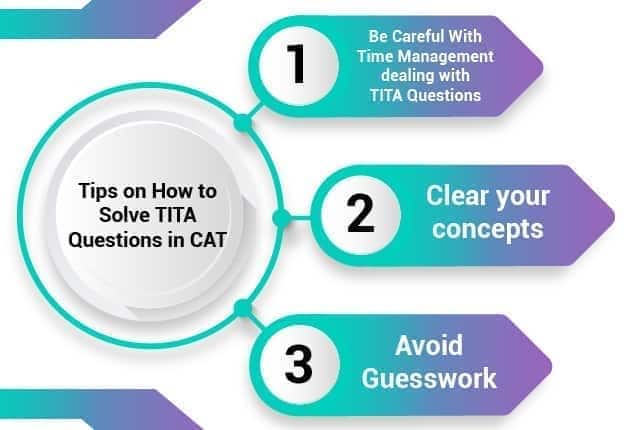
TITA (Type In The Answer) questions in CAT 2026 are non-MCQ questions that test accuracy, calculation skills, and conceptual clarity. Unlike MCQs, there’s no option to guess, making precision essential. Using the right study material for CAT, understanding topic-wise patterns, and practising regularly can significantly improve accuracy.
1. Classify the Question Type
The first step in solving TITA questions is to identify the topic: Arithmetic, Algebra, Geometry, Permutation & Combination, Probability, or Logical Reasoning. Each type demands a different approach. Arithmetic questions may require ratio, percentage, or speed-distance formulas, while Permutation & Combination or Probability questions rely on combinatorial rules. Recognising the type early, using techniques from your study material for CAT, saves time and reduces errors in selecting the solving method.
2. Extract Key Data
Carefully note all values, units, and constraints in the question. TITA questions often include hidden traps like unusual units, decimal placements, or boundary conditions. Avoid assumptions and record intermediate numbers clearly on rough sheets. Proper extraction ensures the correct application of formulas from your study material for CAT and prevents simple mistakes, which are costly since TITA answers cannot be guessed.
3. Apply Correct Formulas Precisely
Use topic-specific formulas accurately for each question type. For example, Arithmetic may need time-speed-distance formulas, sum/product rules, or logarithmic identities. Algebra questions may require the CAT formula sheet for sequence or quadratic solutions. Geometry needs area/perimeter or coordinate-based equations. Applying formulas correctly, as outlined in trusted study material for CAT, ensures accuracy, especially in multi-step TITA questions where one small error can invalidate the final answer.
4. Break Down Multi-Step Problems
Many TITA questions involve multiple calculations or layered reasoning. Solve step-by-step, writing intermediate results clearly. For example, in a sequence or DI-based TITA question, calculate totals, averages, or ratios in stages instead of combining steps mentally. This reduces errors and aligns with systematic methods suggested in your study material for CAT, allowing error-free final answers.
5. Check Feasibility & Edge Cases
After solving, verify that your answer meets all constraints, integer values, maximum/minimum limits, or logical conditions. For instance, probability questions should always yield results between 0 and 1. Edge-case verification ensures that TITA answers comply with all conditions in the CAT exam.
Use Approximation Smartly
Some TITA questions allow rounded or approximate answers. Apply approximation carefully, keeping the required decimal places in mind. Use estimation techniques from your study material for CAT, such as rounding intermediate steps or using fraction-to-decimal conversions. Incorrect approximation can lead to errors in final answers, so only use it when the question permits.
Types of TITA Questions in CAT 2026
TITA (Type In The Answer) questions in CAT 2026 are designed to test accuracy, calculation speed, and conceptual clarity. They do not provide options, so candidates must enter exact numerical or logical answers. Using reliable study material for the CAT helps understand patterns and formulas required for each type. Key types include:
1. Arithmetic-Based TITA Questions
These involve calculations in percentages, ratios, averages, time-speed-distance, work-time, and simple/compound interest. Precision is critical since rounding errors can lead to wrong answers. Candidates should apply step-wise formulas from the study material for CAT, check units, and verify totals before submission.
2. Algebra & Sequence TITA Questions
Questions may include linear and quadratic equations, arithmetic/geometric sequences, inequalities, and functions. Correct identification of variables and systematic substitution is crucial. Using formula sheets and examples from the study material for CAT ensures faster calculations and reduces the chances of mistakes in multi-step solutions.
3. Geometry & Mensuration TITA Questions
These questions test areas, volumes, perimeters, coordinate geometry, and trigonometry. Accurate formula application is critical, mistakes in a single step can render the answer invalid. Regular practice from the study material for CAT helps memorise formulas and identify shortcuts for quick calculation.
4. Permutation, Combination & Probability TITA Questions
These questions require counting techniques, factorials, combinations, and probability rules. Correct formula selection is essential; misinterpreting constraints or conditions often leads to errors. Practising topic-wise examples from the study material for CAT strengthens understanding and calculation speed.
5. Logical Reasoning & Data Interpretation TITA Questions
Candidates may face sequence arrangement, puzzles, matrix problems, bar/line/column chart DI, and critical reasoning. TITA questions in LR/DI demand precise numeric or single-answer outputs. Using topic-specific notes and solved examples from the study material for CAT helps identify patterns and improve accuracy.
CAT TITA Questions Strategy 2026
TITA questions in CAT 2026 demand precise solving without the support of options. These questions test your ability to apply concepts directly, making them different from MCQs. A well-planned CAT TITA strategy 2026 can improve both speed and accuracy.
1. Focus on Conceptual Strength
A strong conceptual foundation is the key to solving TITA questions with confidence. These questions do not offer answer choices, so you must rely entirely on your understanding of the topic. Whether it’s solving equations in Quant, analysing sets in DILR, or interpreting passages in VARC, only solid concepts will help you arrive at the correct answer. Therefore, you must adhere to the best CAT books.
Candidates should strive to clarify their concepts from a basic level. Start with easy examples and gradually move to standard-level questions. Rushing into complex problems without mastering the basics often leads to avoidable mistakes in TITA formats.
2. Break Down Every Step While Practising
Writing each step while solving a TITA question helps minimise careless errors and improves overall accuracy. Since there are no answer options to guide or verify your solution, missing a single step or calculation can lead to an incorrect final response. A structured, step-by-step approach not only improves clarity but also builds consistency, which is essential when using any reliable CAT non-MCQ questions approach.
This habit forms a core part of an effective CAT 2026 preparation strategy. Many students try to solve mentally or skip steps to save time, but this often leads to mistakes—especially in TITA questions where the margin for error is very small.
3. Use CAT Practice Sessions
Solving TITA questions within strict time limits helps improve both speed and accuracy. Since these questions don’t offer answer choices, you must rely entirely on your calculations and logic. That’s why practising them under time pressure is essential. It simulates the real exam environment and builds mental stamina for the actual test day.
Suppose you start preparing for the CAT without coaching. In that case, you can still build strong time management habits through self-study. Begin by solving a fixed number of TITA questions every day using a stopwatch or online timer. Allocate time per question based on the actual CAT format. This helps in developing speed without compromising accuracy.
4. Attempt When the Answer is Clear
TITA questions may seem risk-free because they don’t carry negative marking, but guessing randomly is rarely helpful. While there’s no penalty for wrong answers, typing in answers blindly can waste valuable time that could be spent on questions you understand better. A focused and selective approach works far more effectively than attempting everything.
A common question among aspirants is, "How many questions should I attempt in the CAT to get the 99th percentile?" The answer depends on the difficulty level of the slot and your accuracy. However, consistently attempting 55–60% of the questions with high accuracy is usually enough.
Mistakes to Avoid While Solving CAT TITA Questions
TITA questions in the CAT Mock Test 2026 can be scored if approached wisely, but many aspirants lose marks due to avoidable mistakes. Since these questions do not provide options, accuracy and precision are everything. Being aware of common errors helps candidates attempt them with confidence and improve their overall performance.
Skipping Rough Work
Many students try to solve TITA questions mentally. This often leads to small calculation errors. Always use rough work to write down steps and verify before typing the final answer.
Overestimating Time
Spending too long on one TITA can disturb your overall rhythm. If the solution path isn’t clear within a minute, it’s better to mark, move on, and revisit later.
Ignoring Units or Formats
The answers in TITA must be typed correctly. Missing units (like percentage, ratio, or decimal placement) or miswriting numbers can cost you marks despite knowing the concept.
Random Guessing
While there’s no negative marking, typing random numbers wastes time. TITA should be attempted logically; educated attempts are better than blind guessing.
Misreading Questions
TITA problems are often worded in tricky ways. Misunderstanding what is asked (e.g., average vs. total, percentage vs. fraction) leads to wrong answers even with correct calculations.
CAT Ebooks 2026 by Careers360
CAT Ebooks 2026 by Careers360 are a convenient part of study material for CAT, offering topic-wise theory, solved examples, and practice questions. They cover Quantitative Aptitude, VARC, and Logical Reasoning and help aspirants to study anytime and strengthen concepts efficiently.
eBook Title | Download Links |
3000+ Most Important Words - Vocabulary Builder | |
500+ Most Important Idioms and Phrases | |
300+ Most Important Phrasal Verbs | |
Mastering CAT Exam: VARC, DILR, and Quant MCQs & Weightages | |
CAT 2026 Verbal Ability and Reading Comprehension (VARC) Study Material | |
CAT 2026 Exam's High Scoring Chapters and Topics | |
CAT Mock Test Series - 20 Sets, Questions with Solutions By Experts | |
Permutation & Combination - Video Lectures and Practice Questions | |
Boost your CAT preparation with a comprehensive 60-day study material by Experts | |
Mastering DILR Questions with Expert Solutions |
Frequently Asked Questions (FAQs)
Q: What are TITA questions in CAT?
A:
TITA stands for Type In The Answer. These questions do not have options, and candidates must type the correct answer using the keyboard.
Q: Is there negative marking for TITA questions in CAT 2026?
A:
No, there is no negative marking for incorrect TITA answers, but marks are awarded only for correct entries.
Q: Which topics usually have TITA questions?
A:
TITA questions often appear in Quantitative Aptitude topics like Arithmetic, Algebra, Number Systems, and Geometry. Some Logical Reasoning and Data Interpretation questions may also be TITA, requiring precise calculation or reasoning.
Q: Is attempting all TITA questions a good strategy in CAT?
A:
Not every TITA is designed to be attempted, many are traps with heavy calculation or ambiguous framing. Prioritise only those TITA questions where data is clean and solvable within 2–3 minutes to maintain a healthy time-to-mark ratio.
Q: How to solve TITA questions in CAT 2025?
A:
To solve TITA (Type In The Answer) questions in CAT 2025, start by carefully reading the question to understand the requirement, as there are no answer options to guide you. Focus on logical reasoning and precise calculations, as these questions often test conceptual clarity. Avoid guesswork since there is no negative marking, but aim to attempt only those questions where you are confident.
Q: How can I improve speed and accuracy for TITA questions?
A:
Practice with previous CAT papers and mock tests specifically for TITA questions. Focus on shortcuts, formula memorisation, and mental calculations to reduce reliance on paper. Time management is essential to attempt all TITA questions correctly.
Q: In which sections are TITA questions asked in CAT 2026?
A:
TITA questions appear in all three sections of the CAT 2026 examination: VARC, DILR, and Quantitative Aptitude.
Q: How many TITA questions in the CAT?
A:
The number of TITA questions in CAT varies each year but usually ranges between 10 to 14 questions across all three sections.
Q: Are TITA questions more difficult than MCQs?
A:
TITA questions may feel harder because there are no options to guess from, and accuracy in calculation and logic is required.
Q: How should students prepare for CAT 2026 TITA questions?
A:
Students should practice calculation-based questions, improve accuracy, and solve previous year CAT TITA questions regularly.
Articles
Related Stories
|
Explore Top Universities Across Globe
Popular Courses and Specializations
List of colleges accepting CAT

Questions related to CAT
On Question asked by student community
Have a question related to CAT ?
Hello,
Here you can get study material for CAT :
https://bschool.careers360.com/download/ebooks/cat-quantitative-aptitude-questions-answers-pdf
Hope it helps !
Hello aspirant,
A timetable is essential if you are preparing for the CAT in addition to your college coursework. It will give you an idea of how long it will take you to finish your syllabus and then set aside the appropriate amount of time for revision and mock exams.
Hello Nikita,
To get into any of the top IIMs, such as IIM Ahmedabad, Bangalore, Calcutta, Lucknow, Kozhikode, or Indore, a good percentile in CAT is required, although academics play a vital role too. Let's break it down below:
CAT Score: 98+ percentile is an excellent score and makes one
Hello!
Prep for CAT 2024: Application Pattern
Syllabus: Focus on those areas that fall under the syllabus; for instance, Quantitative Aptitude, Verbal Ability & Reading Comprehension, and Data Interpretation & Logical Reasoning.
Books: Stick to standard books from renowned authors, say, Arun Sharma for Quant, Norman Lewis in vocabulary, and
Hello,
While starting your CAT preparation late can be challenging, it's still possible to achieve a good score with focused effort. Prioritize understanding the exam pattern, and focus on key areas like Quantitative Ability, Data Interpretation, Logical Reasoning, and Verbal Ability.
Create a structured study plan, practice regularly with mock

MBA/PGDM Admissions OPEN
Ranked among top 10 B-Schools in India by multiple publications | Top Recruiters-Google, MicKinsey, Amazon, BCG & many more.
N. L. Dalmia Institute of Management, PGDM Admissions 2026
ApplyAICTE Approved | NBA Accredited | NAAC A+(2nd Cycle) Accredited. Highest CTC: 24 LPA | Average CTC: 11.17 LPA
Siva Sivani Institute of Management PGDM Admissions 2026
Apply98.74% Students Placed | 180+ Recruiters on Campus | Average CTC 7.25 LPA
Indus University MBA Admissions 2026
ApplyHighest CTC 16 LPA | Top Recruiters: Accenture, TCS, Tech Mahindra, Capgemini, Microsoft
Reva University MBA Admissions 2026
ApplyLast Date to Apply: 25th May | QS I-Gauge Diamond Rated | NAAC A+ Accredited | 621 Recruitment Partners | INR 40 LPA Highest CTC | 4482 Job offers
SCSVMV Deemed to be University | MBA Admissions 2026 Open
ApplyMBA At at SCSVMV | NAAC 'A' Grade | AICTE & UGC Aproved | 100% Placement Support | Merit-based Scholarships
CAT Notifications
Never miss CAT update
Get timely CAT updates directly to your inbox. Stay informed!